


Ever finished a beautiful custom tumbler, held it up in the light, and then completely froze when a customer asked, "How much do you charge?" You're not alone. Pricing is hands-down one of the hardest parts of running a laser engraving business — and one of the most important.
Charge too little and you're essentially paying your customers to take your work. Charge too much without the brand to back it up and orders dry up fast. The sweet spot lives somewhere in between, and this guide will show you exactly how to find it.
Quick answer: Most laser engraving services charge between $1–$3 per minute of machine time, or $25–$50 per hour for shop rate depending on complexity, location, and overhead. But those numbers only make sense once you understand what's driving them — so let's dig in.
Before we get into the numbers, here's a helpful video walkthrough on how to think about pricing your laser engraving work from a business perspective:
Before picking a number, you need a system. Gut-feel pricing is how most beginners end up making $8 an hour and wondering why they're exhausted. The formula that experienced engravers use looks like this:
Final Price = (Materials + Labor + Machine Wear + Overhead) × Profit Margin
Each component matters. Skip one and you're subsidizing your customers without realizing it.
This means the actual cost of the blank or substrate you're engraving — wood, acrylic, metal, leather, glass, or whatever you're working with. If you bought materials in bulk, break the cost down to a per-unit figure. Always add a 10–15% buffer for waste and mistakes, especially on intricate designs. A ruined blank still costs you money.
This is where most beginners undercharge. Labor isn't just the time the laser is running — it includes file prep, design adjustments, loading and aligning the material, monitoring the job, cleanup, and packaging. A reasonable starting point is $25–$40 per hour for your own time, adjusted up or down based on your experience and local market.
Track every step of your workflow. You may think a tumbler takes 15 minutes, but once you account for setting up the rotary attachment, testing the file, and wrapping the finished piece, that single job often runs 30–40 minutes.
Your laser isn't free to run. Lenses, belts, and tubes degrade over time. A CO2 laser tube typically has a lifespan of around 10,000 hours, and replacements aren't trivial. Budget roughly $1–$2 per machine hour toward depreciation and consumables as a reasonable baseline.
Overhead covers everything else: electricity, workspace costs, software subscriptions (LightBurn, design tools), packaging supplies, and insurance. A simple way to handle it — add up your monthly overhead and divide by the number of jobs you complete. If your overhead is $500/month and you do 40 jobs, that's $12.50 per job going straight to keeping your doors open.
Once you've calculated your true cost, add your margin on top. A starting point of 20–30% is standard for most product-based businesses, but engraving — especially personalized or emotionally significant items — can often support much higher margins. A well-established Etsy seller or local engraver can realistically aim for 40–60% margins on the right products.
"Pricing is one of the most important facets of any product lifecycle. Starting a laser engraving home business without thinking about pricing beforehand is a recipe for failure." — LaserEngravingTips.com
There's no single right method — and most experienced engravers actually use a mix depending on the job type. Here's how each approach works in practice.
This is the most widely used method among small engraving businesses. You charge a set rate for every minute of machine run time — typically $1–$3 per minute for CO2 and diode lasers, with higher rates for fiber lasers or complex setups. It naturally accounts for design complexity: a detailed photo engraving that runs 45 minutes costs more than a simple name that takes 8 minutes. Just make sure your per-minute rate is high enough to cover labor and overhead, not just machine wear.
Flat rates work well for standardized products — think custom coasters, keychains, cutting boards, or tumblers. A flat $25 for an engraved coaster set or $40 for a personalized tumbler removes friction at checkout. Customers know what they're paying, and you can quote jobs without pulling out a calculator every time.
The risk is underpricing when a job ends up taking longer than expected. Flat rates are safest for items you've already done enough times to know the real time cost.
For larger, more unpredictable jobs — bulk corporate orders, complex signage, or anything with significant prep work — billing by the hour plus materials is the safer option. Most businesses charge $25–$50 per hour for the service component, then add the actual cost of materials on top.
Common for signage, plaques, and flat panel work. Typical rates range from $0.50–$1.00 per square inch, though specialized engravers or those working with premium materials charge more. This method is transparent and easy for customers to understand when comparing quotes.
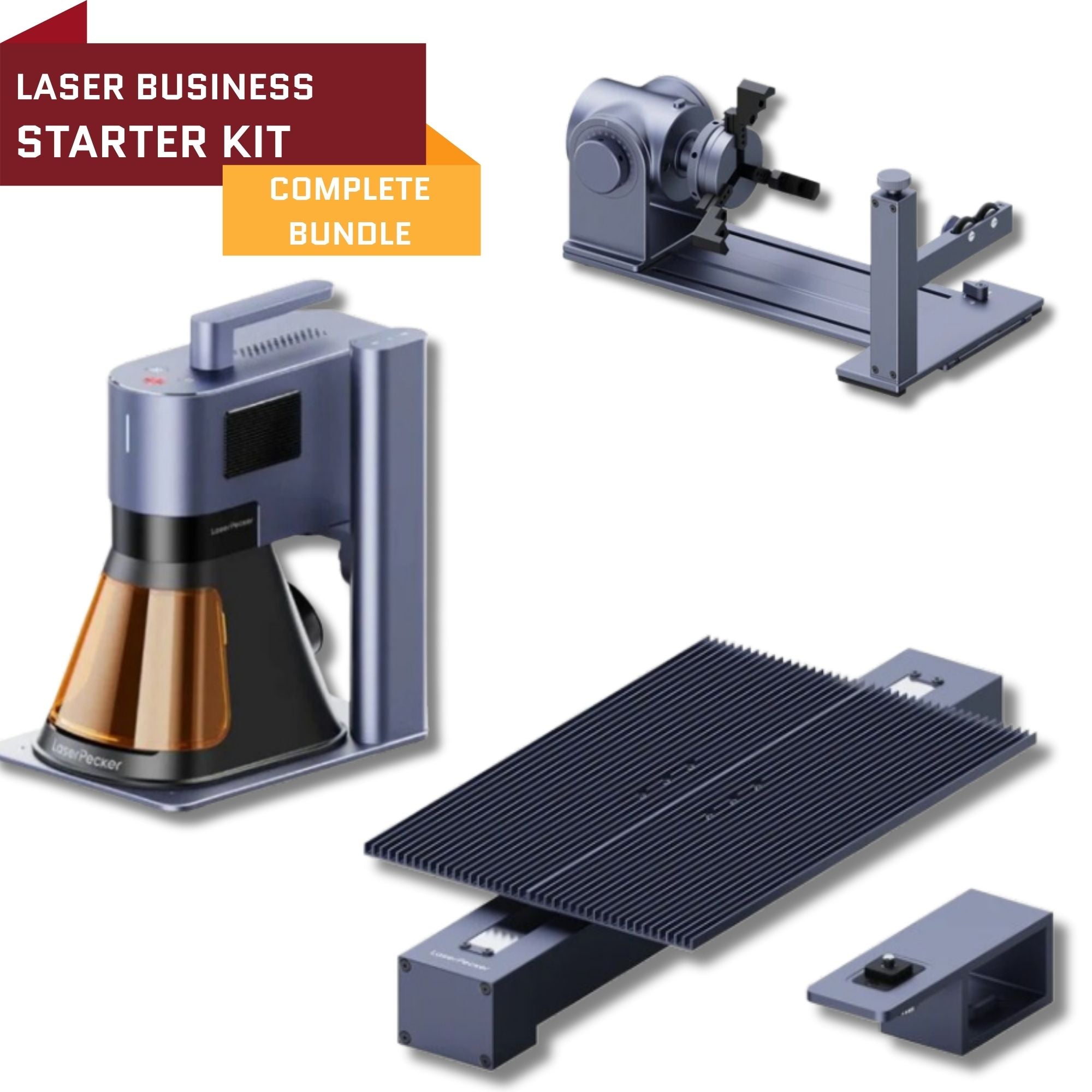
A portable, professional laser engraving system designed to help entrepreneurs launch a laser engraving business quickly. Create custom products on metal, wood, leather, plastic, and more with a versatile dual-laser engraver.
View Full Product DetailsBenchmarks matter. Knowing what the market actually pays helps you stay competitive without leaving money on the table.
One of the most popular laser engraving products. On Etsy, custom engraved tumblers typically sell for $25–$50 depending on design complexity, tumbler brand, and personalization. If you're sourcing quality blanks and producing sharp, consistent results, the higher end of that range is absolutely achievable.
A perennial bestseller. Laser engraving on a standard wood cutting board typically runs $35–$75 at retail, depending on size and design. A 14"x24" board with a family name or custom recipe tends to sit around $40–$55 for a mid-tier listing, while premium hardwood versions command more.
Memorial plaques, recognition awards, and custom signs often start at $75 and go well past $200 when crafted from premium wood, marble, or granite. These are high-value, low-volume pieces where value-based pricing (see below) really shines.
Slate or wood coaster sets are inexpensive to produce and look premium when well-engraved. Sets of four typically sell for $25–$50, and they're a great entry-level product for building your portfolio.
Engraved pendants, rings, and keychains sit in the $20–$60 range for most consumer-facing listings. Metal engraving — especially on rings or watches — commands a premium because of the added skill and risk involved.
Home decor signs and office nameplates start around $30–$50 for simple pieces but scale quickly with size and material. Businesses often pay $75–$200+ for branded signage, especially on premium substrates like walnut or brushed metal.

Cost-plus pricing is your foundation. You calculate your real cost and add a margin. It keeps you profitable and consistent. For bulk orders, repeat products, or any job where margins are thin, this is the method to default to.
Value-based pricing is where the real money often lives. Instead of asking "what did this cost me to make?" you ask "what is this worth to the buyer?" A personalized wedding plaque might cost you $25 to produce — materials, machine time, labor — but to the person who's hanging it in their home to mark one of the most important days of their life, $120–$150 is completely reasonable.
Savvy engravers switch between both depending on the job. Use cost-plus for corporate bulk orders and repeat catalog items. Shift to value-based for one-of-a-kind, emotionally significant pieces like memorial items, wedding gifts, and baby gifts.
One practical shortcut that successful engraving business owners swear by is the 4-to-6x multiplier. The idea is straightforward: your retail price should be at least 4 to 6 times your total material cost to maintain healthy margins.
So if a blank tumbler costs you $5, a retail price of $25–$30 is your minimum target. If a wood cutting board blank runs $8, you're looking at $32–$48 as a baseline. This rule doesn't replace the full pricing formula, but it's a fast gut-check when you're evaluating a new product or getting a quote request on short notice.
Every job requires setup time — loading the file, aligning the material, running a test pass. That's true whether you're engraving one keychain or fifty. For that reason, most experienced engravers set a minimum order of $25–$30 to ensure that even the smallest job is worth firing up the laser.
For bulk orders, graduated pricing helps you lock in larger commitments while protecting margins:
| Quantity | Price Per Unit (Example: Tumbler) |
|---|---|
| 1–10 | $30 each |
| 11–50 | $25 each |
| 50+ | $20 each |
Businesses love bulk pricing tiers because it gives them something to aim for. And once a corporate client places one order at the 50+ tier, they almost always come back for more.
One important note: volume discounts should reflect your actual efficiency gains — not panic pricing. Your fixed costs don't disappear just because someone orders more. Make sure the per-unit price at the highest tier still covers your materials, overhead, and a reasonable margin.
These are two charges that many new engravers are afraid to apply — and that fear costs them real money.
A setup fee of $10–$30 per custom job covers the time you spend preparing artwork, cleaning up customer-provided files, running test passes, and calibrating your machine for that specific material. It's not gouging — it's accurate billing. Most professional shops include it as standard, and customers who understand the process rarely push back.
A rush fee of 25–50% is equally justified for same-day or next-day turnaround. Expedited jobs disrupt your production schedule, often require you to drop other work, and create stress. That has a price. Charge for it transparently and the right customers will have no problem paying it.

If you're selling on Etsy, factor in their 6.5% transaction fee plus listing and payment processing fees — these can eat 10–15% of your revenue depending on the sale price. Shopify charges a monthly subscription plus payment fees. Amazon Handmade has its own fee structure. If you're pocketing $20 on a $30 item after platform fees and shipping materials, your effective margin is probably much lower than you think.
Many engravers solve this by setting slightly higher base prices on marketplace platforms and offering local pickup pricing for in-person or direct customers. Different channels, different rates — that's not inconsistent, it's smart.
An engraver in a major metro area can charge more than one in a small rural market — not because the work is better, but because the cost of living, customer expectations, and average household income all support higher price points. Research your local market, not just national Etsy averages. What sells in Brooklyn at $65 may need to be $35 in a smaller market to move at the same volume.
Once your base pricing is solid, add-ons are the fastest way to grow revenue without adding complexity.
If a customer provides a low-resolution image or a rough idea that requires real design work on your end, charge for it. Artwork creation or cleanup typically runs $15–$75 depending on complexity. You are not just operating a machine — you're bringing creative and technical expertise.
Paint fill in engraved lettering, metallic inlays, protective clear-coat finishes — these small additions transform a good piece into a great one, and customers will pay a premium for the upgrade. Even a simple black paint fill adds perceived value that can justify an extra $10–$20 per item. Glossy finishes and protective coatings also increase durability, which is a legitimate selling point.
Combining an engraved item with a laser-cut box, matching coasters, or a complementary accessory turns a single $40 sale into an $80–$100 package. Bundled listings consistently outperform single-item listings on visual marketplaces because they photograph better and feel more complete. Add premium packaging — a kraft box, tissue paper, a branded sticker — and you've built a gift-ready product that commands a gift-ready price.
Custom names, dates, logos, or special messages often justify a 20–50% markup over a generic version of the same item. Personalization takes time and creates risk (a mis-spelled name means a ruined blank), so price that reality into the product. Customers who want something made just for them expect to pay more.
Knowing what not to do is just as useful as knowing what to do. These are the traps that catch most beginners:
Pricing materials as free. If you already own the blanks, it's tempting not to factor them in. Don't. Every item you engrave has a replacement cost, and treating materials as free is just a slower way to drain your inventory budget.
Only charging for machine run time. The laser running is maybe 30–40% of the total time involved in a job. Design work, file prep, setup, cleanup, and communication all count. Bill for all of it.
Copying competitor prices without calculating your own costs. Someone else's prices reflect their costs, their machine, their overhead, and their margin goals — not yours. Use competitor research to understand the market ceiling, but build your prices from the bottom up based on your actual numbers.
Being afraid to raise prices. If you're consistently booked out and turning work away, your prices are probably too low. The market is telling you something. Raising prices by 10–15% rarely causes the customer exodus most engravers fear — and it can dramatically improve profitability.
The most sustainable thing you can do for your engraving business is build a simple pricing spreadsheet. It doesn't need to be complex. Create rows for: material cost per unit, time in minutes, your per-minute rate, overhead per job, and profit margin. Once it's built, you can quote almost any job in under two minutes.
Many engravers create separate tabs for their most common products — tumblers, coasters, cutting boards, signage — with preset formulas that auto-calculate based on quantity and customization level. When a bulk order comes in, you're not guessing. You're running a number through a proven system.
Review your costs and rates every three to six months. Materials prices fluctuate. Your overhead may change. And as your skills and reputation grow, your labor rate should reflect that growth.
A portable, professional laser engraving system designed to help entrepreneurs launch a laser engraving business quickly. Create custom products on metal, wood, leather, plastic, and more with a versatile dual-laser engraver.
View Full Product DetailsWhich Laser Engraver Should I Buy – 10 W, 20 W, CO₂ or Diode?
How to Choose the Right Laser Engraver for Your Small Business
Most small laser engraving businesses charge between $25–$50 per hour for service work, depending on your location, experience, and the type of projects you take on. Higher-end commercial shops in urban markets or those working with complex materials like metal or glass can justify rates of $50–$150 per hour. The key is making sure your hourly rate covers all your real costs — labor, machine wear, overhead, and profit — and isn't just a number you pulled from a competitor's pricing page. Your rate should reflect your actual cost structure, not someone else's.
The four main factors are material type, design complexity, engraving time, and quantity. Materials that require more laser power — like metal or glass — cost more to work with than wood or acrylic. A detailed photo engraving takes significantly longer than a simple name or monogram, which directly increases labor and machine costs. Bulk orders are generally cheaper per unit due to setup efficiencies, while single custom pieces command a premium. Geography and platform fees (if you sell on Etsy or Amazon) also play a real role in what you can realistically charge.
Start with your formula: add up your material cost, labor time (in minutes), machine wear, and a share of your overhead, then multiply by your profit margin. For custom jobs specifically, make sure to include a setup fee of $10–$30 to cover file preparation and any artwork cleanup. If the customer is providing their own design file, verify it's production-ready before quoting — poorly formatted files can double your prep time. Custom jobs often carry more risk (a mistake on a unique item can't be easily replaced), so factor that into your margin accordingly.
Absolutely — and most professional engravers do. Even a single engraved keychain requires you to load the file, set up the machine, align the material, and run a test pass. That's billable time. A standard setup fee of $10–$30 per custom job ensures you're not working for free on the non-machine parts of your workflow. Customers who understand the craft rarely object to a reasonable setup charge, and those who do are often not the right customers for custom work. Setting a minimum order of $25–$30 achieves a similar outcome and is an easy policy to communicate upfront.
For bulk orders, use a tiered pricing structure that rewards volume while protecting your margins. A typical approach might be $30/unit for 1–10 pieces, $25/unit for 11–50, and $20/unit for 50+. Before applying any discount, verify that the lowest tier still covers your material cost, allocated overhead, labor, and a workable margin. Bulk orders may reduce per-unit setup time, but they increase total machine hours and the risk of a costly mistake mid-batch. Corporate clients often also expect faster turnaround and consistent quality standards, which has value — don't give that away in the pricing.
Yes, without question. Different materials require different laser settings, take longer to engrave, and carry different levels of risk. Wood and acrylic are forgiving and fast — they're your baseline. Metal (especially uncoated metal requiring fiber lasers) is slower and demands more skill. Glass is fragile and requires careful speed and power calibration to avoid cracking. Leather varies widely depending on quality and thickness. A simple rule: the more difficult or risky the material, the higher your rate should be. Many engravers maintain a material surcharge schedule rather than recalculating from scratch every time.
They affect it more than most sellers realize. Etsy charges a 6.5% transaction fee plus listing fees and payment processing — combined, this can represent 10–15% of your sale price. Shopify has monthly fees plus per-transaction charges. Amazon Handmade takes a referral fee on each sale. If you're pricing the same item identically across all platforms without accounting for these differences, you're making less on some channels than you think. The standard fix is to build platform fees into your price on each channel, or to maintain slightly higher prices on marketplace platforms versus your own website where fees are lower.
At a minimum, review your pricing every 3–6 months. Material costs fluctuate — blank prices go up, shipping changes, and consumables like lenses and exhaust filters need replacing. Your overhead may shift too, especially if you move to a larger workspace or upgrade your machine. Beyond cost changes, consider your demand level: if you're consistently turning away work or booked out weeks in advance, that's a clear signal your prices are below market. Raising prices by 10–15% at a time is manageable for existing customers and quickly becomes the new normal. The biggest pricing mistake most engravers make isn't charging too much — it's never raising their rates at all.
Shipping Insurance ($89)

Leave a comment